The biggest challenge of the energy transition? Not technology, but capacity
What if the biggest challenge of the energy transition is not technology, but capacity? That question was central to a gathering by LUMO Labs and Van Lanschot Kempen, where Integer had the opportunity to present itself to a select group of investors and industry professionals.
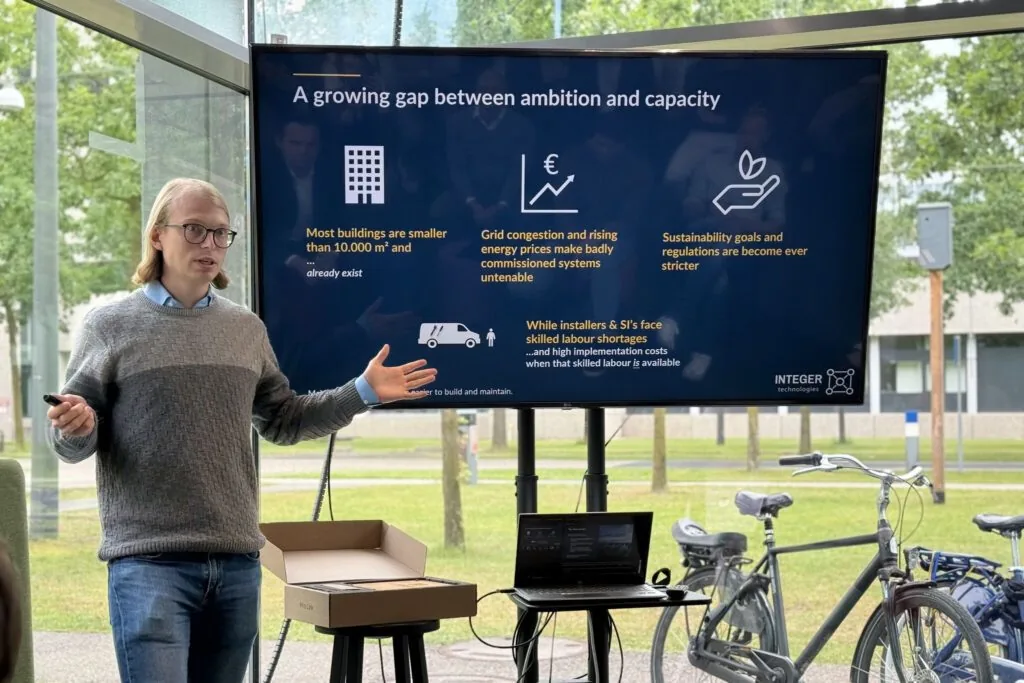
During the event, the discussion covered developments around AI, new business models and the competitive advantages that may determine which companies succeed in the coming decade. One theme stood out clearly: the enormous task of making existing buildings sustainable and future-proof at scale.
Millions of buildings face a major renovation task
In the coming years, Europe faces an extensive renovation task. Buildings need to be adapted as a result of, among other things, grid congestion, rising energy costs, outdated installations and stricter sustainability requirements. Regulations, such as the obligations around GACS (building automation and control systems), are also accelerating this development.
The opportunities are great, but at the same time there is an important bottleneck: there are simply not enough specialised engineers, commissioning specialists and building management system experts to optimise millions of buildings the traditional way. That leads to a fundamental choice: train and deploy more technical specialists, accept that sustainability progresses too slowly, or radically change the way building optimisation is carried out. Integer explicitly chooses the latter.
From complex engineering to plug-and-play
Advanced building optimisation has traditionally depended heavily on lengthy engineering processes, specialist knowledge and manual configuration. That is why Integer is developing a different approach.
By combining smart hardware with self-learning software, Integer has developed a plug-and-play platform that can automatically connect existing installations, create a Digital Twin of the building and enable predictive control. AI and Model Predictive Control (MPC), among other things, are used to control buildings more intelligently and efficiently.
The goal is not to develop technology for the sake of technology. It is about one important question: how do we make building optimisation scalable? As Antoine Post explained during the event: “Millions of buildings face a renovation task. Integer turns this challenge into a plug-and-play solution.”
Scalability as the key to impact
The conversations with investors and industry professionals confirmed an important conviction of Integer: the next generation of successful climate-tech companies will not only develop better technology, but above all ensure that this technology can be applied much more easily and quickly.
That is essential to actually tackle the major sustainability task at scale. By reducing technical complexity and the dependence on specialist engineering, room is created to apply smart energy technology much more widely. The challenge is big. So is the potential impact.
Integer thanks LUMO Labs and Van Lanschot Kempen for organising this inspiring gathering and for bringing together entrepreneurs, investors and innovators who are working on the next step in the energy transition.