A building without grid congestion can still help solve the problem
“A building that doesn't suffer from grid congestion can still help solve it.” With that thought, Integer took part in a panel discussion by Rabobank Real Estate during PROVADA. The central question was how the real estate sector can contribute to solving the growing problems around grid congestion.
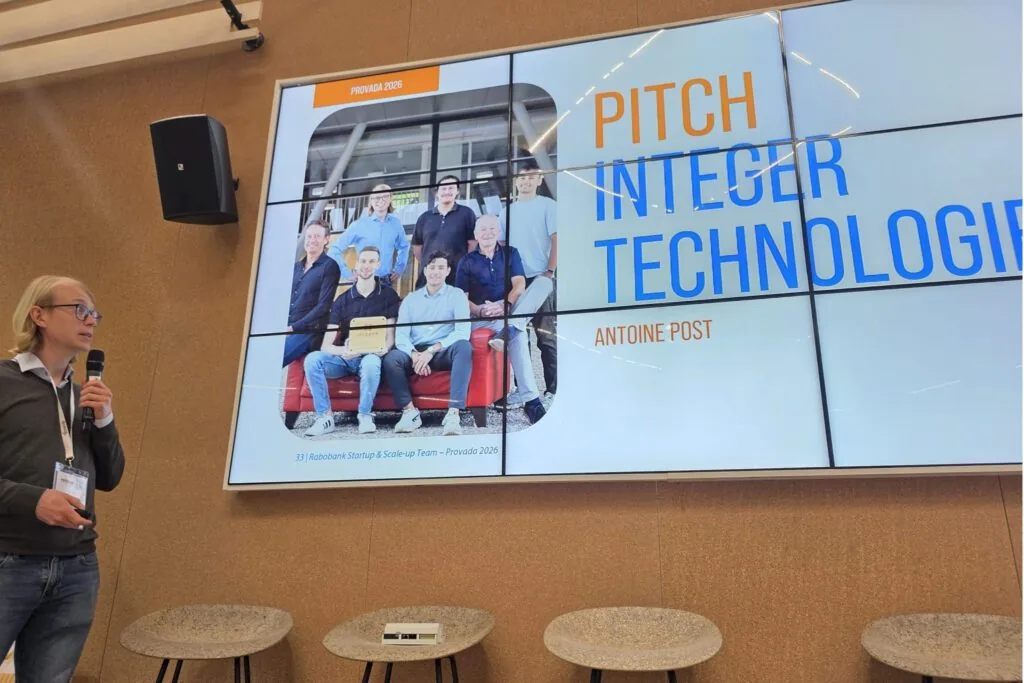
During the session, our co-founder Antoine Post shared how predictive climate control can help steer energy demand more intelligently. By predicting energy use and adjusting installations accordingly, buildings can lower their peak load, use energy more efficiently and create flexibility on the electricity grid, without compromising the comfort of building users.
Grid congestion calls for collaboration
The panel discussion brought together different perspectives from the energy chain. Alongside Integer, Bart Louwerenburg of Skoon Energy, Koen Mulders of Currentt and Maurits Hilwig of Rabobank Real Estate Finance took part in the conversation. One important conclusion kept coming back: grid congestion is not a problem with a single solution. It is a complex issue in which energy infrastructure, real estate, technology, regulation and user behaviour all come together. That is exactly why collaboration between different parties is essential.
Buildings as part of the solution
Buildings face several challenges at the same time. They have to lower their energy consumption, comply with new regulations such as GACS, deal with limited grid capacity and, at the same time, provide a comfortable indoor climate.
These issues cannot be solved separately. Smart energy management makes it possible to connect different goals. By not only making buildings more energy-efficient, but also controlling them flexibly, they can actively contribute to a more stable energy system. This means that even a building that does not suffer from grid congestion itself can play a role in reducing it.
From smart buildings to a smarter energy system
For Integer, this vision ties in directly with the mission to make building technology simpler, smarter and more scalable to apply. With smart and predictive control technology, existing buildings can respond better to changing conditions on the electricity grid. Events such as PROVADA are valuable in this respect. Not only to share knowledge and vision, but above all to make new connections and explore opportunities together.
Integer thanks Rabobank Real Estate Finance for the invitation and Wouter Truffino for moderating the discussion. We also look back with pleasure on the conversations with existing relations and new organisations, including MAECONOMY.
The energy transition will not be realised by individual organisations. It calls for collaboration, innovation and the willingness to create value together. And according to Integer, that is exactly where the future of smart buildings lies: buildings that not only use less energy, but actively contribute to a more flexible and future-proof energy system.