How Team CASA is building the future of sustainable living
In 2016, Antoine Post was a bachelor's student in applied physics at Eindhoven University of Technology (TU/e). After joining the TU/e honors academy, he came up with the idea of putting together a student team to develop a sustainable housing concept. Other students were enthusiastic about his idea, and shortly afterwards Team CASA was founded.
Team CASA is one of the student teams of Eindhoven University of Technology (TU/e), with the mission of accelerating the energy transition in the construction sector. The students want to achieve this by developing alternative, affordable and sustainable housing solutions.
Mihnea Mateescu is a third-year bachelor's student of architecture at TU/e and the current team captain of Team CASA. He has been leading the team for just over a year. Mihnea joined the team at a challenging moment, when only a few members were left after earlier projects. Team CASA's mission remains unchanged: developing sustainable building projects.
The beginning
It took five years, from September 2016, to complete the mission of the first generation of Team CASA: building a sustainable apartment complex. The concrete-free building has three apartments and is made of steel and wood. Thanks to a smart combination of solar panels and a heat pump, it has an ingenious heating and cooling system.
“It was never about setting up a student team,” says Antoine. “We wanted to create a housing concept that could really inspire the market.” From finding a place to build to dealing with rising steel prices due to COVID-19: the students saw it all.
The team started from scratch. “The idea was to build the concept within two years, but that was actually unrealistic. Still, it was fantastic to see how everyone contributed in their own way.”
The same vision, a different project
According to the current team captain, reviving the team was quite a challenge. Working together did not come naturally. Last year, the team took part in an architecture competition. That brought the group closer together and prepared them for the current project.
“We have started working with Meteor, a new café on the TU/e campus, to design a study space,” says Mihnea. “We are working on an indoor and an outdoor space. The use of recycled materials is central, and the elements we design must be modular and adaptable.”
To that end, the students are working on custom-made furniture from bio-based materials such as cork, and are exploring smart, innovative lighting solutions to improve the atmosphere. The goal this year is to complete the project and try out new technologies. “Think of furniture with sensors that automatically adjust the seating position to the user's posture,” he explains.
Creating impact
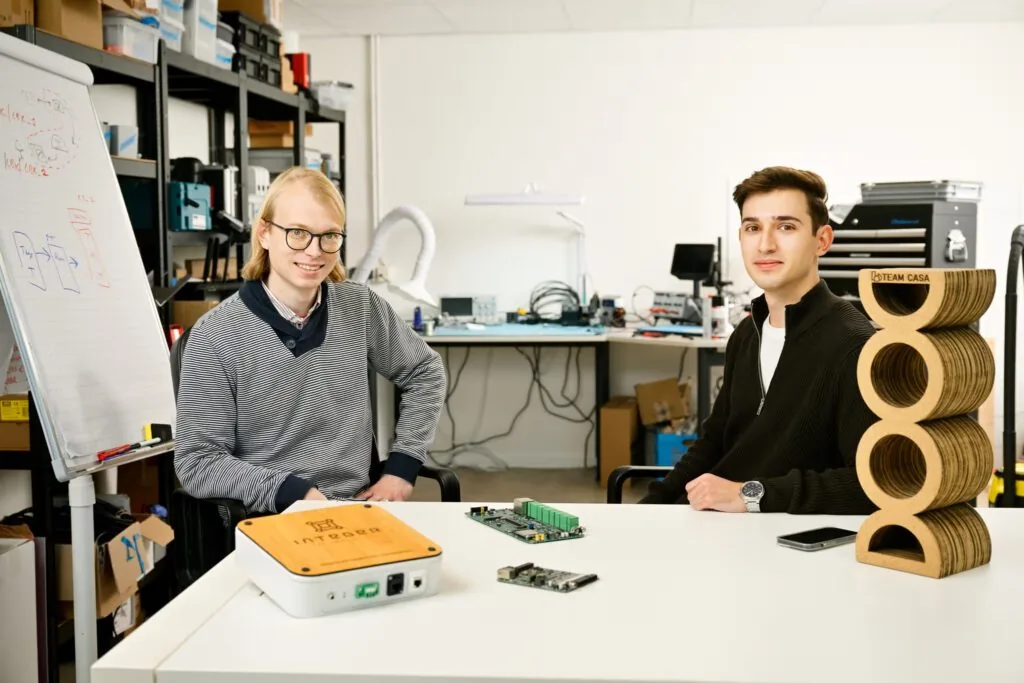
For Antoine, Team CASA has always been more than a side activity during his studies. He still lives in the house and, together with team member Pau Brossa Rodriguez, founded Integer Technologies.
What struck companies that visited CASA 1.0 most was the control system: the brain of the building that controlled and optimised the solar panels and the heat pump. “They asked whether we could also make such a system for office buildings. That is how Integer came about,” Antoine recalls.
Integer Technologies has developed that technology further. For example, the start-up has developed a smart box that controls heating, ventilation and air conditioning. The technology is currently used in ten buildings.
The human factor
Teamwork always has a human side. As team captains, both Antoine and Mihnea had to learn to lead a group and make use of everyone's talents.
Antoine sees a student team as a collection of people with different backgrounds, skills and attitudes. “Some join a team because they like the mission, others because it looks good on their CV, or simply because they want to belong somewhere.”
For Mihnea, as a bachelor's student, it is particularly valuable to get a taste of how an architecture project unfolds and how to deal with stakeholders. “As team captain, you learn how important it is to make decisions,” he says. “If all 15 of us were involved in every discussion every time, that would only slow the process down.”
An extra learning experience
Skills development, hard work and fun are the main ingredients behind every student team. The two team captains can only recommend other students to join a team. “Being part of a student team gives you a head start. You gain extra experience while growing as a person at the same time,” says Mihnea.
According to Antoine, taking part in a student team means you learn in a very different way than when you study for exams. “Most importantly, through this experience you come into contact with many more factors, such as working with companies and institutions, which you would never come into contact with as a student.”